
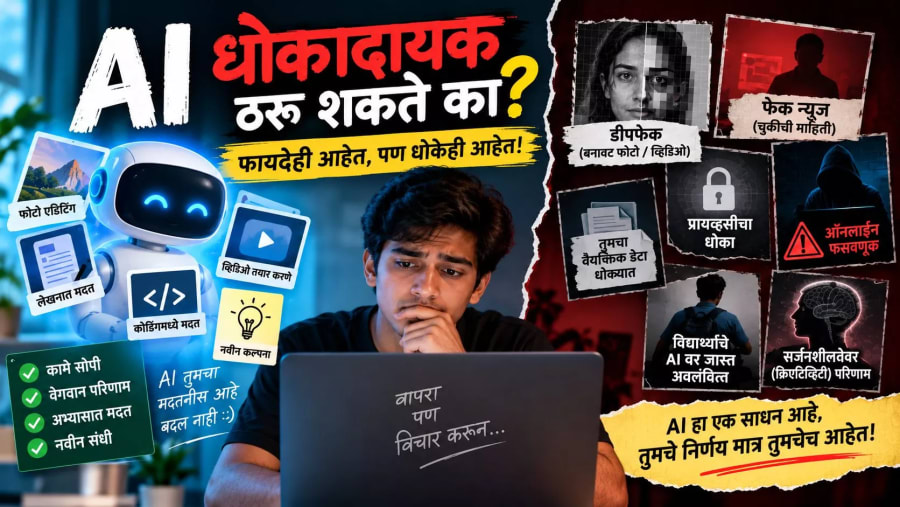
आजकाल AI बद्दल आपण रोज काही ना काही ऐकत असतो. काही वर्षांपूर्वी ज्या गोष्टी आपल्याला अशक्य वाटत होत्या, त्या आता AI मुळे काही सेकंदांत करता येतात.
फोटोमध्ये बदल करायचा असेल, एखादा लेख लिहायचा असेल, व्हिडिओ तयार करायचा असेल, कोडिंगमध्ये मदत हवी असेल किंवा एखादी माहिती समजून घ्यायची असेल—AI अनेक कामांमध्ये आपली मदत करत आहे.
म्हणूनच AI खूप उपयोगी आहे, यात शंका नाही.
पण प्रत्येक नवीन तंत्रज्ञानाप्रमाणे AI चेही काही धोके आहेत.
विशेषतः आपण AI चा वापर किती आणि कशासाठी करतो, याकडे लक्ष देणे गरजेचे आहे.
म्हणून प्रश्न असा नाही की “AI चांगली आहे की वाईट?”
खरा प्रश्न असा आहे—
“AI वापरताना आपण कोणती काळजी घेतली पाहिजे?”
AI मुळे Privacy धोक्यात येऊ शकते
आजकाल AI फोटो बनवण्याचे वेगवेगळे ट्रेंड सोशल मीडियावर पाहायला मिळतात.
उदाहरणार्थ, सध्या 80s-90s स्टाईलचे फोटो खूप लोकप्रिय झाले आहेत. आपला एक फोटो AI टूलमध्ये टाकायचा आणि त्यासोबत एक prompt द्यायचा. काही वेळात AI आपला फोटो जुन्या काळातील असल्यासारखा बनवून देते.
फोटो छान दिसतो आणि तो सोशल मीडियावर शेअर करण्याचा मोह होतो.
पण यावेळी आपण एक गोष्ट विसरतो—
आपला फोटो आपण एका AI सेवेला दिलेला असतो.
आपला चेहरा हा फक्त एक साधा फोटो नाही. तो आपल्या ओळखीचा महत्त्वाचा भाग आहे.
म्हणून कोणत्याही AI टूलवर आपला personal फोटो टाकण्यापूर्वी थोडा विचार करणे चांगले.
फोटो काही सेकंदांसाठी वापरायचा असतो, पण तो कोणत्या digital system मधून जातो हे आपल्याला नेहमीच पूर्णपणे माहीत असेल असे नाही.
तुमचा चेहरा म्हणजे तुमची ओळख
आपण password विसरलो तर तो बदलू शकतो.
PIN बदलू शकतो.
Email password बदलू शकतो.
पण चेहरा?
चेहरा बदलणे आपल्या हातात नसते.
AI मध्ये फोटो process करताना चेहऱ्याच्या वेगवेगळ्या वैशिष्ट्यांचे विश्लेषण केले जाऊ शकते. त्यामुळे personal face फोटो हा इतर सामान्य फोटोसारखा सहज share करण्यासारखा data नाही.
याच कारणामुळे personal face फोटो अनावश्यकपणे AI tools वर upload न करणे हा privacy च्या दृष्टीने चांगला नियम ठरू शकतो.
“पण AI कंपनी तर विश्वासार्ह आहे!”
अनेकजण म्हणतील—
“मी कोणत्याही अनोळखी वेबसाइटवर फोटो टाकत नाही. मी तर प्रसिद्ध AI वापरतो.”
हा विचार समजण्यासारखा आहे.
विश्वासार्ह सेवा वापरणे आणि अनोळखी वेबसाइट वापरणे यात नक्कीच फरक आहे.
पण privacy च्या दृष्टीने आणखी एक प्रश्न विचारायला हवा:
“माझा personal फोटो या सेवेला देण्याची खरंच गरज आहे का?”
जर एखाद्या कामासाठी personal फोटो देणे आवश्यकच नसेल, तर तो फोटो share न करणे हा अधिक सुरक्षित पर्याय आहे.
म्हणजे AI कंपनीवर आरोप करायचा असा मुद्दा नाही.
फक्त एवढेच—
अनावश्यक personal data share न करणे हीच चांगली privacy सवय आहे.
Privacy Policy असली तरी सावध राहा
आजकाल जवळपास प्रत्येक मोठ्या online service कडे Privacy Policy असते.
त्यामध्ये तुमचा data कसा वापरला जाऊ शकतो, किती काळ ठेवला जाऊ शकतो किंवा कोणत्या कारणासाठी process केला जाऊ शकतो याबद्दल माहिती दिलेली असते.
Privacy Policy असणे चांगली गोष्ट आहे.
पण त्याचा अर्थ “आता कोणताही धोका नाही” असा होत नाही.
Online services च्या policies, features आणि data-handling पद्धती भविष्यात बदलू शकतात.
म्हणून privacy बाबतीत एक साधा नियम उपयोगी पडतो:
ज्या personal माहितीची गरज नाही, ती online share करू नका.
AI आणि 80s-90s Photo Trend
सध्या अनेक लोक आपले फोटो AI ला देऊन 80s किंवा 90s मधील फोटोसारखे images तयार करत आहेत.
उदा. तुम्ही तुमचा selfie upload करता आणि prompt देता:
“Make this photo look like an authentic 1990s Indian photograph with vintage clothes, retro hairstyle and old film-camera effect.”
AI त्यावरून एक नवीन image तयार करते.
पाहायला हा ट्रेंड मजेदार आहे.
पण एकदा विचार करा—
फक्त एका trend साठी आपला personal face AI ला देणे आवश्यक आहे का?
आज 80s-90s trend आहे.
उद्या दुसरा trend येईल.
मग AI avatar, cinematic portrait, childhood photo, celebrity-style photo असे आणखी trends येतील.
प्रत्येक trend साठी आपण आपले फोटो AI ला देत गेलो तर आपले कितीतरी personal photos वेगवेगळ्या services सोबत share होऊ शकतात.
म्हणून प्रत्येक नवीन AI trend पाहून लगेच “आपलाही फोटो बनवूया” असे करण्याआधी थोडा विचार करा.
Deepfake चा धोका
AI मुळे फोटो आणि व्हिडिओमध्ये खूप realistic बदल करता येऊ लागले आहेत.
एखाद्या व्यक्तीचे अनेक फोटो आणि व्हिडिओ इंटरनेटवर उपलब्ध असतील तर त्यांचा वापर करून त्या व्यक्तीसारखे दिसणारे बनावट किंवा बदललेले content तयार करण्याचा धोका वाढू शकतो.
यामध्ये:
-
बनावट फोटो
-
बनावट व्हिडिओ
-
खोटी सोशल मीडिया प्रोफाइल
-
एखाद्याच्या नावाने केलेली फसवणूक
-
दिशाभूल करणारे content
यांचा समावेश होऊ शकतो.
याचा अर्थ असा नाही की तुम्ही एक फोटो AI ला दिला आणि लगेच तुमचा deepfake तयार होईल.
पण आपले personal photos जितके कमी ठिकाणी share केले जातील, तितके privacy exposure कमी ठेवता येईल.
AI मुळे Fake News वाढू शकते
पूर्वी खोटी बातमी तयार करण्यासाठी एखादा बनावट लेख किंवा edited फोटो वापरला जायचा.
आता AI मुळे बनावट:
फोटो + व्हिडिओ + आवाज + मजकूर
तयार करणे अधिक सोपे झाले आहे.
एखाद्या व्यक्तीने काहीतरी बोलल्याचा fake video तयार केला जाऊ शकतो किंवा एखाद्या घटनेचा खोटा फोटो तयार केला जाऊ शकतो.
म्हणून आता इंटरनेटवर एखादा फोटो किंवा व्हिडिओ दिसला म्हणून तो लगेच खरा मानणे योग्य नाही.
“दिसतंय म्हणजे खरं आहे” हा नियम AI च्या काळात चालणार नाही.
महत्त्वाची माहिती मिळाल्यावर तिचा source तपासणे गरजेचे आहे.
AI वर जास्त अवलंबून राहण्याची सवय लागू शकते
AI आपले काम खूप सोपे करते.
पण हीच गोष्ट कधी कधी आपल्यासाठी समस्या बनू शकते.
आज आपण AI ला म्हणतो:
“हे लिहून दे.”
“हा email तयार करून दे.”
“याचा निर्णय सांग.”
“याचे उत्तर दे.”
“माझ्यासाठी idea शोध.”
हे सगळे करण्यासाठी AI उपयोगी आहे.
पण प्रत्येक छोट्या गोष्टीसाठी AI वरच अवलंबून राहण्याची सवय लागली तर आपण स्वतः विचार करण्याचा प्रयत्न कमी करू शकतो.
AI ने आपल्याला मदत करावी, पण आपल्याऐवजी सगळा विचार करू नये.
विद्यार्थ्यांनी AI चा वापर कसा करावा?
विद्यार्थ्यांसाठी AI खूप उपयोगी ठरू शकते.
एखादा कठीण विषय समजून घेण्यासाठी, प्रश्न सोडवण्याची पद्धत शिकण्यासाठी किंवा अभ्यासाचे नियोजन करण्यासाठी AI ची मदत घेता येते.
पण जर विद्यार्थी प्रत्येक homework आणि assignment AI कडून करून घेऊन फक्त copy-paste करत राहिला तर त्याचा स्वतःचा अभ्यास कमी होईल.
Assignment पूर्ण होईल.
पण शिकायला मिळेल का?
हा खरा प्रश्न आहे.
AI कडून उत्तर घेण्यापेक्षा उत्तर कसे मिळाले हे समजून घेण्यासाठी AI चा वापर करणे जास्त फायदेशीर आहे.
AI ने दिलेले प्रत्येक उत्तर बरोबर असेलच असे नाही
AI खूप हुशार वाटते.
ती आत्मविश्वासाने उत्तर देते.
पण कधी कधी AI कडून चुकीची किंवा अपूर्ण माहितीही मिळू शकते.
विशेषतः:
-
आरोग्य
-
पैसे आणि गुंतवणूक
-
कायदा
-
सरकारी नियम
-
शिक्षण
-
महत्त्वाचे निर्णय
यांसारख्या विषयांमध्ये AI चे उत्तर मिळाले म्हणून ते लगेच खरे मानू नका.
AI कडून माहिती घ्या, पण महत्त्वाची माहिती तपासा.
AI मुळे Jobs मध्ये बदल होऊ शकतो
AI अनेक repetitive कामे वेगाने करू शकते.
त्यामुळे काही कामांच्या पद्धती बदलत आहेत आणि भविष्यात आणखी बदल होऊ शकतात.
याचा अर्थ “AI सर्वांच्या नोकऱ्या घेणार” असा सरळ निष्कर्ष काढणे योग्य नाही.
पण एक गोष्ट नक्की आहे—
AI मुळे काम करण्याची पद्धत बदलत आहे.
म्हणून AI सोबत काम करता येणे, नवीन skills शिकणे आणि बदलत्या technology सोबत स्वतःला update ठेवणे महत्त्वाचे होईल.
AI मुळे आपली Creativity कमी होऊ शकते का?
आज AI ला prompt दिला की ती poster, image, story किंवा design तयार करून देते.
यामुळे आपले काम सोपे होते.
पण प्रत्येक creative काम AI कडूनच करून घेत राहिलो तर स्वतःची कल्पना करण्याची आणि प्रयोग करण्याची सवय कमी होऊ शकते.
AI ने आपली creativity वाढवावी.
आपली creativity बंद करू नये.
तुमची स्वतःची कल्पना आधी येऊ द्या आणि AI ला ती आणखी चांगली करण्यासाठी मदतनीस म्हणून वापरा.
AI Scams अधिक हुशार होऊ शकतात
Scams नवीन नाहीत.
पण AI मुळे scam messages अधिक नैसर्गिक आणि विश्वासार्ह वाटू शकतात.
AI च्या मदतीने बनावट:
-
आवाज
-
फोटो
-
messages
-
emails
-
social-media profiles
तयार करणे सोपे होऊ शकते.
म्हणून एखाद्या ओळखीच्या व्यक्तीच्या नावाने किंवा आवाजात पैसे मागणारा message आला तर फक्त आवाज किंवा message पाहून विश्वास ठेवू नका.
दुसऱ्या माध्यमातून त्या व्यक्तीची खात्री करा.
मग AI पूर्णपणे वाईट आहे का?
नाही.
AI मुळे अनेक चांगल्या गोष्टी शक्य होत आहेत.
अभ्यास, coding, translation, research, accessibility, content creation आणि अनेक कामांमध्ये AI उपयोगी ठरू शकते.
म्हणून AI ला घाबरण्यापेक्षा तिचा वापर समजून घेणे महत्त्वाचे आहे.
AI समस्या नाही; AI चा निष्काळजी वापर समस्या ठरू शकतो.
AI वापरताना या गोष्टी लक्षात ठेवा
🔐 Personal माहिती विचार न करता AI ला देऊ नका.
👤 Personal face आणि sensitive photos अनावश्यकपणे upload करू नका.
📄 Confidential documents अनोळखी AI tools मध्ये टाकू नका.
🧠 AI च्या प्रत्येक उत्तरावर डोळे बंद करून विश्वास ठेवू नका.
🔎 महत्त्वाची माहिती verify करा.
🎓 AI चा वापर शिकण्यासाठी करा, फक्त copy-paste करण्यासाठी नाही.
🚨 AI-generated scams, fake photos आणि videos बाबत सावध रहा.
💡 AI ला assistant म्हणून वापरा, तुमच्या विचारांची जागा घेण्यासाठी नाही.
शेवटी एकच गोष्ट लक्षात ठेवा
AI ही एक powerful technology आहे.
तिच्यामुळे आपले अनेक कामे सोपे झाली आहेत आणि भविष्यात AI आणखी मोठी भूमिका बजावणार आहे.
पण technology कितीही advanced झाली तरी आपली privacy, आपली विचार करण्याची क्षमता आणि आपली स्वतःची ओळख यांची काळजी घेणे आपल्या हातात आहे.
AI कडून मदत घ्या.
पण प्रत्येक गोष्टीसाठी तिच्यावर अवलंबून राहू नका.
AI कडून माहिती घ्या.
पण महत्त्वाची माहिती स्वतः तपासा.
AI ने image तयार करून घ्या.
पण personal फोटो कुठे upload करत आहात याचा विचार करा.
आणि सर्वात महत्त्वाचे—
AI वापरा, पण विचार करून वापरा.
कारण AI कितीही हुशार झाली तरी तुमच्या privacy आणि तुमच्या निर्णयांची जबाबदारी शेवटी तुमचीच आहे.
Can AI Be Harmful? Understanding the Risks of Artificial Intelligence
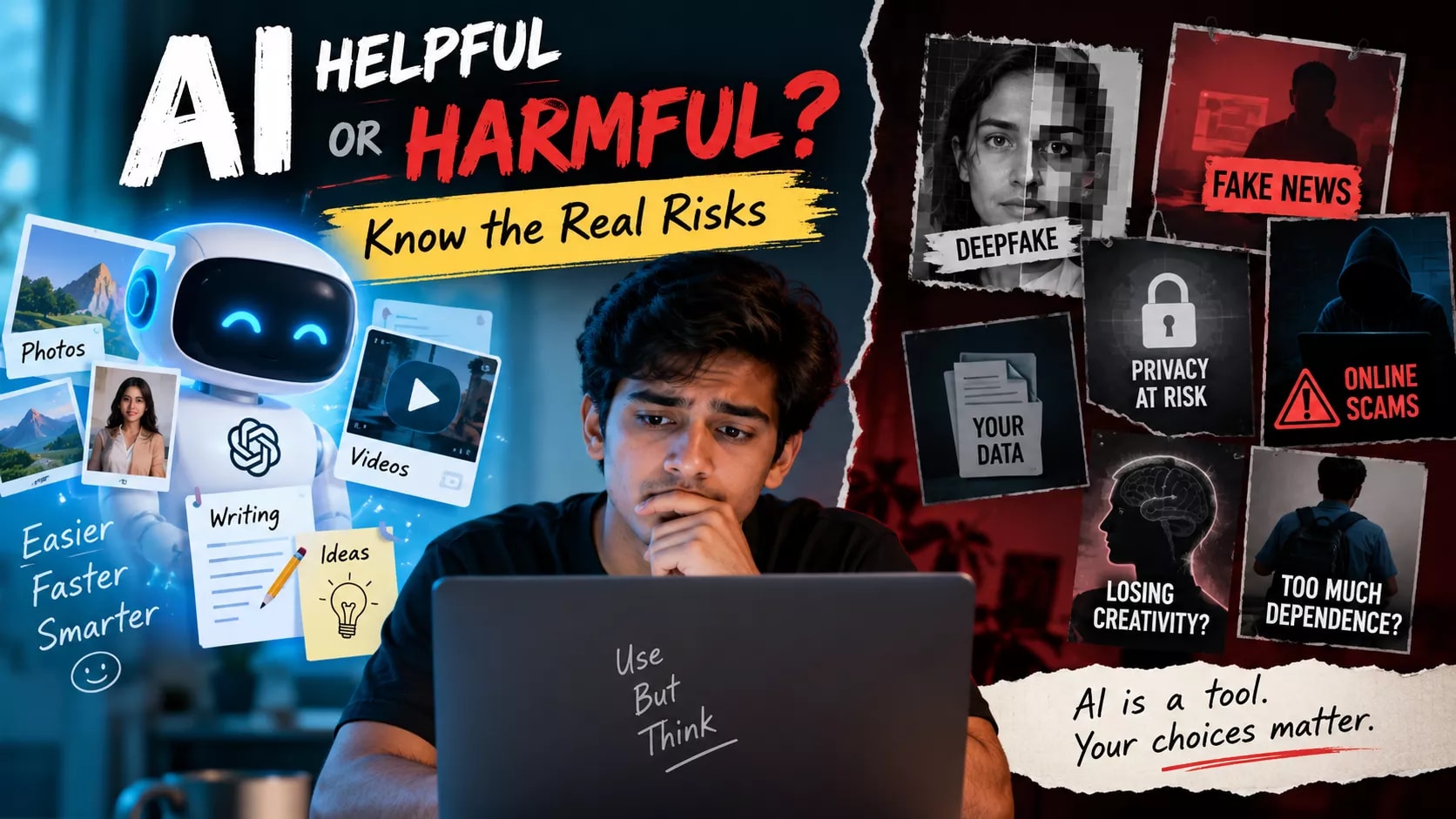
These days, we hear something about AI almost every day. Things that seemed impossible just a few years ago can now be done within seconds with the help of Artificial Intelligence.
Whether you want to edit a photo, write an article, create a video, get help with coding, or understand a difficult topic, AI has become useful in many areas of our daily lives. There is no doubt that AI can make our work much easier. But like any powerful technology, AI also comes with certain risks.The important thing is to understand how much we use AI and what we use it for.
So, the real question is not simply:
“Is AI good or bad?”
The better question is:
“What should we be careful about when using AI?”
AI Can Put Our Privacy at Risk
AI photo editing has become extremely popular, especially on social media.
For example, 80s and 90s-style AI photos have recently become a popular trend. You upload a photo, add a prompt, and within a short time, AI can transform your image into something that looks like it came from another era. The result can look amazing, and naturally, you may want to share it with your friends or post it online.
But there is one thing we often forget—
We have shared our personal photo with an AI service.
Your face is not just an ordinary photo. It is an important part of your identity. That is why it is worth thinking twice before uploading personal photos, face images, or other sensitive information to an AI tool. A photo may take only a few seconds to process, but we may not always know exactly how and where that digital data is handled.
Your Face Is Part of Your Identity
- Think about your passwords.
- If you forget your password, you can change it.
- You can change your PIN.
- You can change your email password.
- But what about your face?
You cannot simply change your face like a password.
When an AI system processes a photo, it may analyze different characteristics of the face. That is why a personal face photo should not always be treated like an ordinary image that can be freely shared everywhere.
For this reason, avoiding unnecessary uploads of personal face photos to AI tools can be a sensible privacy practice.
“But What If the AI Company Is Trusted?”
This is something many people may say:
“I don't upload my photos to random websites. I use a well-known AI service.”
That's understandable. There is certainly a difference between using a reputable service and using an unknown website. But from a privacy perspective, there is another question worth asking:
“Do I really need to give this service my personal photo?”
If a particular task does not actually require your personal photo, not sharing it can be the safer option. This is not about accusing any particular AI company of doing something wrong.
The simple point is: Avoiding unnecessary sharing of personal data is a good privacy habit.
Having a Privacy Policy Does Not Mean There Is Zero Risk
Most major online services have a Privacy Policy. It usually explains how user data may be collected, processed, stored, or used. Having a Privacy Policy is a good thing because users can understand how their data is handled. But it does not mean that there can never be any privacy risk.
Online services can change their:
- policies
- features
- data-handling practices
- storage systems
- business structure
Security incidents can also happen to online services.
That is why a simple rule is useful when it comes to privacy:
If personal information is not necessary, there is no reason to share it online.
AI and the 80s–90s Photo Trend
Many people are currently using AI to turn their modern photos into images that look like they were taken in the 1980s or 1990s.
For example, you can upload a selfie and give a prompt such as:
“Make this photo look like an authentic 1990s Indian photograph with vintage clothes, retro hairstyle and old film-camera effect.”
AI then creates a new image based on your uploaded photo. It can be fun and the results can look surprisingly realistic. But stop for a moment and think:
Do you really need to give an AI service your personal face just to follow a trend?
Today, it may be the 80s–90s trend. Tomorrow, there may be another trend. Then there could be AI avatars, cinematic portraits, childhood transformations, celebrity-style images, and many other viral AI trends. If we keep uploading our personal photos for every new trend, more and more of our personal images may end up being shared with different online services.
So the next time you see a new AI trend, don't immediately think:
“Let's upload our photo and try it.”
Take a moment to think about your privacy first.
The Risk of Deepfakes
AI has made it much easier to create highly realistic changes to photos and videos.
If many photos and videos of a person are available online, they can potentially be used to create manipulated or synthetic content that resembles that person.
This can include:
- fake photos
- fake videos
- fake social media profiles
- impersonation
- misleading content
This does not mean that uploading one photo will automatically result in a deepfake.
However, the fewer places where we unnecessarily share our personal photos, the less our overall privacy exposure can be.
AI Can Make Fake News More Convincing
In the past, fake news might have involved a misleading article or an edited photo.
Today, AI can make it easier to create combinations of:
Photos + Videos + Voices + Text
For example, a fake video could be created to make it appear that someone said something they never actually said. A fake image can also be created to make an event appear to have happened when it did not. This is why we should be careful about believing everything we see online.
“If I can see it, it must be real” is no longer a safe assumption in the age of AI.
Whenever something is important, check the original source before believing or sharing it.
We Can Become Too Dependent on AI
AI makes many things easier.
But sometimes, that convenience can become a problem.
Today, people may ask AI:
“Write this for me.”
“Create this email.”
“Tell me what decision I should make.”
“Give me the answer.”
“Give me an idea.”
There is nothing wrong with using AI for assistance.
The problem begins when we start depending on it for almost every small decision.
If we constantly let AI do the thinking for us, we may spend less time developing our own ability to think, solve problems, and make decisions.
AI should help us—not replace our own thinking.
How Should Students Use AI?
AI can be extremely useful for students. It can help explain difficult topics, show how to solve a problem, create practice questions, or help organize a study plan. But if a student simply asks AI to complete every homework assignment and then copies and submits the answer, the student may miss the most important part—actually learning. The assignment may be finished. But did the student really understand the topic?
That is the real question.
Instead of simply asking AI for answers, students can use it to understand how and why an answer is reached.
AI Does Not Always Get Everything Right
AI can sound very confident when answering a question. But that does not mean every answer is correct.
AI can sometimes provide:
- incorrect information
- wrong dates
- incorrect names
- misleading references
- incomplete answers
This is especially important when dealing with topics such as:
- health
- money and investments
- law
- government rules
- education
- important personal decisions
Don't assume something is correct simply because an AI gave you the answer.
Use AI for information, but verify important facts.
AI May Change the Way We Work
AI can perform many repetitive tasks quickly. Because of this, the way some jobs are performed is changing, and more changes may happen in the future. This does not necessarily mean that “AI will take everyone's jobs.” The reality is more complicated.
But one thing is clear:
AI is changing the way we work.
Learning how to work alongside AI, developing new skills, and keeping up with changing technology may become increasingly important.
Can AI Affect Our Creativity?
Today, you can give AI a simple prompt and get a poster, image, story, or design within seconds. That is certainly convenient. But if we start depending on AI for every creative task, we may spend less time coming up with our own ideas and experimenting on our own. AI should help us improve our creativity. It should not make us stop being creative ourselves.
Let your own idea come first, and then use AI as a tool to develop or improve it.
AI Can Make Scams More Convincing
Online scams are nothing new. But AI can make some scams look and sound more believable.
AI can be used to create:
- fake voices
- fake photos
- convincing messages
- realistic emails
- fake social media profiles
This means that if you receive a message or call that appears to come from someone you know, don't automatically assume it is genuine. If something seems unusual—especially if someone is asking for money or sensitive information—verify it through another method.
A quick confirmation can prevent a serious mistake.
So, Is AI Completely Bad?
No.
This is an important point.
AI is already helping people in many areas, including:
- education
- coding
- translation
- research
- accessibility
- content creation
- data analysis
So the goal should not be to fear AI or completely avoid it. Instead, we need to understand how to use it responsibly.
AI itself is not necessarily the problem; careless or harmful use of AI can be.
Things to Keep in Mind When Using AI
Here are a few simple habits that can help:
🔐 Don't share personal information with AI without thinking about it first.
👤 Avoid unnecessarily uploading personal face photos or sensitive images.
📄 Don't upload confidential documents to unknown AI tools.
🧠 Don't blindly trust every answer generated by AI.
🔎 Verify important information before acting on it.
🎓 Use AI to learn, not simply to copy and submit.
🚨 Stay alert to AI-generated scams, fake photos, and fake videos.
💡 Use AI as an assistant, not as a replacement for your own judgment.
One Thing to Remember
AI is a powerful technology. It has already made many tasks easier, and its role in our lives is likely to grow. But no matter how advanced technology becomes, protecting our privacy, our ability to think independently, and our identity is still our responsibility. Use AI when it can genuinely help you. But don't become dependent on it for everything. Get information from AI. But verify important facts yourself. Use AI to create images when appropriate. But think carefully before uploading personal photos.
And most importantly—
Use AI, but use it thoughtfully.
Because no matter how intelligent AI becomes, the responsibility for protecting your privacy and making your own decisions ultimately remains with you.